Use case
A commercial is thirty seconds that has to survive being watched closely. cutipAI is where you build one: the product, the presenter and the location held as references, the shots planned before they are generated, and the whole thing cut and exported without leaving the project.
A fifteen- to sixty-second spot is typically eight to twenty shots. That is short enough that a viewer holds the whole thing in their head at once — which is exactly why continuity errors that would pass unnoticed in a longer piece are the first thing anyone spots. A pack that changes colour between the hand shot and the hero shot, or a presenter whose face is subtly not the same person after the cut, reads as cheap before it reads as anything else.
It is also the format with the least tolerance for a fix. There is no B-roll to cut away to and no second act to recover in; the shot has to be right, and the surrounding shots have to agree with it.
Before any shot is generated, the recurring pieces become entities in the project. The product is an object with its own reference, down to the detail that identifies it. The presenter or talent is a character with a face and a wardrobe held across shots. The location is a space you can return to from a different angle instead of describing again and hoping.
This is the part that is genuinely different from prompting your way through a spot. Once those three exist, each shot says who and where rather than restating what everything looks like — see how the references work.
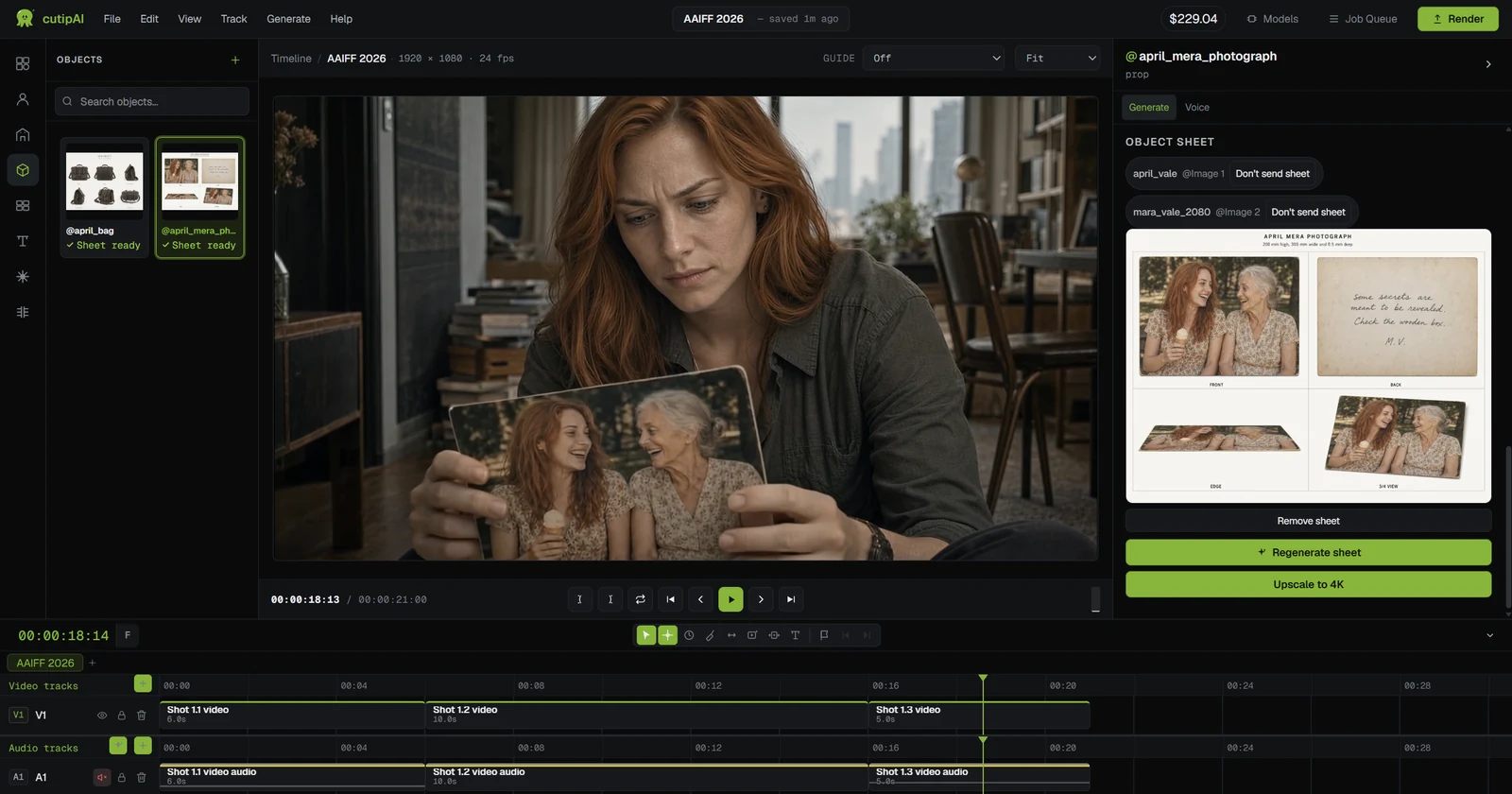
Scenes and shots are planned on the storyboard, and each generation shows an estimated cost before it runs — so the decision about which shots are worth generating is made while it is still cheap to change.
A product turn and a performance close-up want different generation strengths. The approach changes shot by shot while the campaign stays in one project.
Dialogue voices and lipsync come from the lines written into the shot, and music and captions are added in the same timeline as the picture.
Generated shots and any footage you shot yourself land in the same timeline, and the finished spot is exported from it — with 4K upscaling and reframing available when a delivery needs them.
One spot is rarely one deliverable. The same cut has to work as a widescreen pre-roll, a vertical placement and a square one, and re-generating the film three times is both expensive and a guarantee that the three versions will not match.
Reframing is a server-priced operation on the edit you already have, so the alternate aspect ratios come from the same shots rather than from three separate productions.
Yes — the product becomes an object reference in the project, built from the images you bring. You are responsible for holding the rights to any material you import, which for client work usually means you already do.
Yes. Your own footage imports into the same timeline as the generated shots. Local media stays on your machine and is linked rather than uploaded.
It depends entirely on how many shots you generate and how many times. Each generation shows an estimated cost before it runs, the final charge is the actual cost and can land either side of the estimate, and a generation that fails or is cancelled is not charged.
No. cutipAI is the workspace you make it in. You direct the shots, choose what to generate and assemble the cut.
Build the product, the talent and the location once, board the spot, and generate against references the whole campaign shares.